ABTS certification programmeApplications now open
ABTS certification is open to battery manufacturers.
Battery manufacturers can now apply for ABTS certification, establish a verified digital product record and prepare an ABTS Transparency Label for products entering the Australian market.
Manufacturer applications Evidence review Digital product record ABTS certification
Now operational
A working Australian battery transparency and certification layer.
ABTS now accepts applications from battery manufacturers seeking a transparent Australian product record and certification pathway.
Existing international Battery Passport data can remain the foundation. ABTS reviews the product information and supporting evidence needed to establish the Australian record, certification status and label.
Global Battery PassportInternational product data
ABTS Australian LayerContext, continuity and transparency
Australian Battery EcosystemMarket and regulatory applications
Certification infrastructure
One certified product record across the battery lifecycle.
Certification connects the physical battery to its digital product record, supporting product identification, market transparency and future updates across installation, operation, repair, reuse and end of life.
Transparency label
Essential information beside the battery, presented in a standardised format.
Digital identity
A unique identifier linking to the complete technical and evidence record.
Lifecycle framework
Data continuity supporting multiple market, operational and regulatory uses.
The long-term vision
One battery. One digital identity. Multiple market and regulatory applications.
- 01Identity and origin
- 02Manufacturer and technology
- 03Chemistry and technical characteristics
- 04Safety and performance
- 05Supply chain
- 06Installation and deployment
- 07Operational lifecycle
- 08Sustainability
- 09Repair, reuse and recycling
- 10Long-term market and regulatory applications
Battery transparency is about more than data
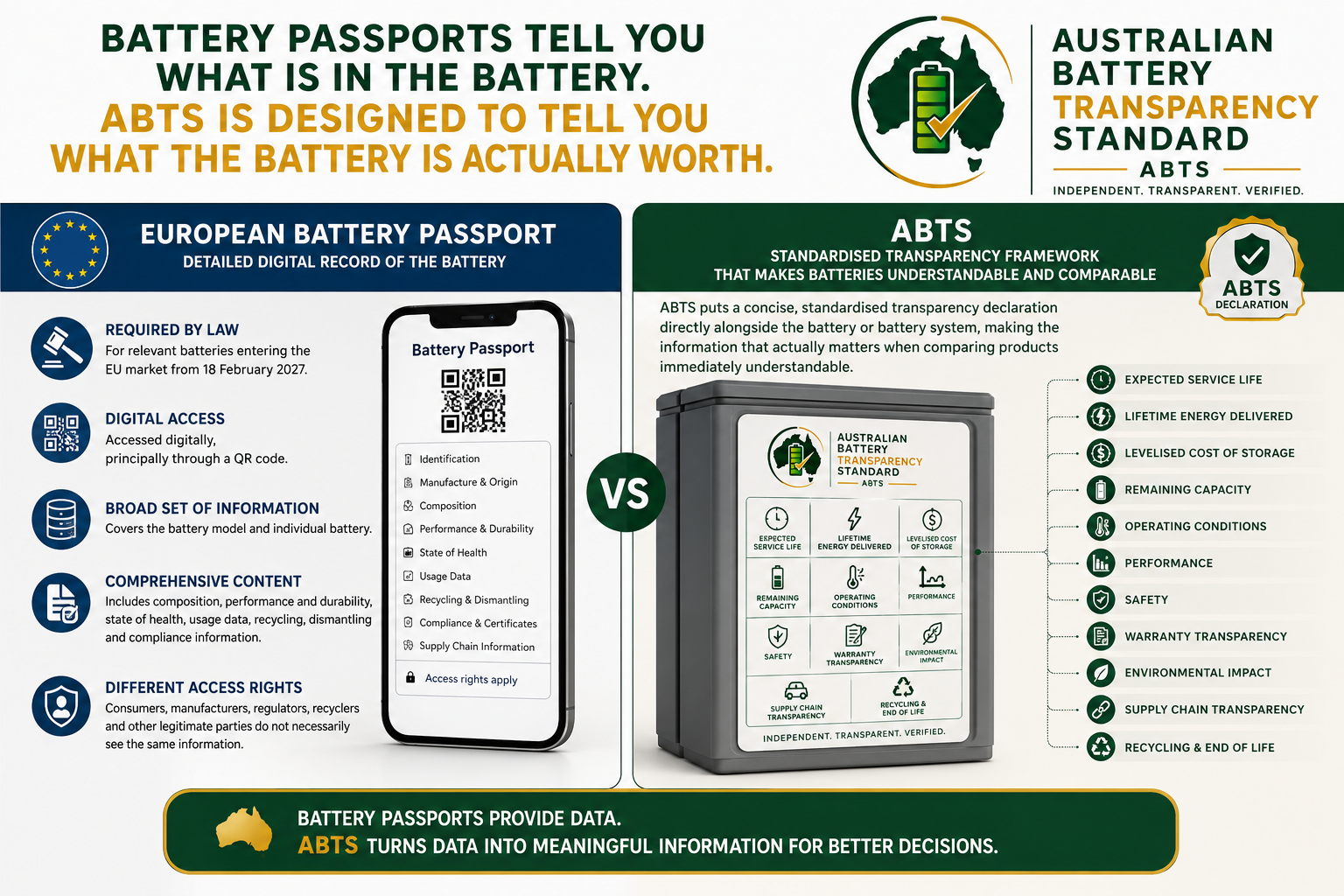
Battery Passports provide data. ABTS makes it understandable.
A Battery Passport is a detailed digital record. ABTS is a standardised transparency framework designed to bring the information that matters most directly alongside the battery or battery system.
Lifetime value and levelised cost Operating conditions and performance Safety and warranty transparency Environmental impact and end of life
Our vision
Certified information for every battery decision.
ABTS provides an Australian product transparency layer that helps manufacturers present battery information consistently and helps buyers, installers, asset owners and market participants understand the evidence behind product claims.
Better information supports better purchasing, policy, investment and long-term sustainability outcomes.
Who we support
Homeowners Commercial businesses Installers Manufacturers Developers Utilities Government Investors
Our principles
Independent. Transparent. Evidence based.
Independent
Information should be developed without favouring a product, manufacturer or battery chemistry.
Transparent
Criteria, evidence requirements and limitations should be clearly published and understood.
Evidence based
Claims should be supported by consistent data, defined methods and appropriate scrutiny.
Consumer focused
Complex battery information should be presented in a form people can use confidently.
Industry integration
Useful transparency depends on reliable product data moving consistently across manufacturers, markets and lifecycle participants.
Sustainability
Environmental impact, recycling and end-of-life responsibility should be visible.
The information gap
Price is visible.
Performance is not.
Key claims remain difficult to find, interpret or compare. ABTS proposes a common language for the facts that matter over a battery’s full life.
Expected service life
How long the complete system is expected to remain useful.
Lifetime energy delivered
The total usable energy expected across the product’s life.
Levelised cost of storage
The real cost of every kilowatt hour delivered over time.
Remaining capacity
The usable capacity expected at the end of the warranty period.
Operating conditions
The temperatures and environments covered by performance claims.
Recycling pathway
What happens to the product and its materials at end of life.
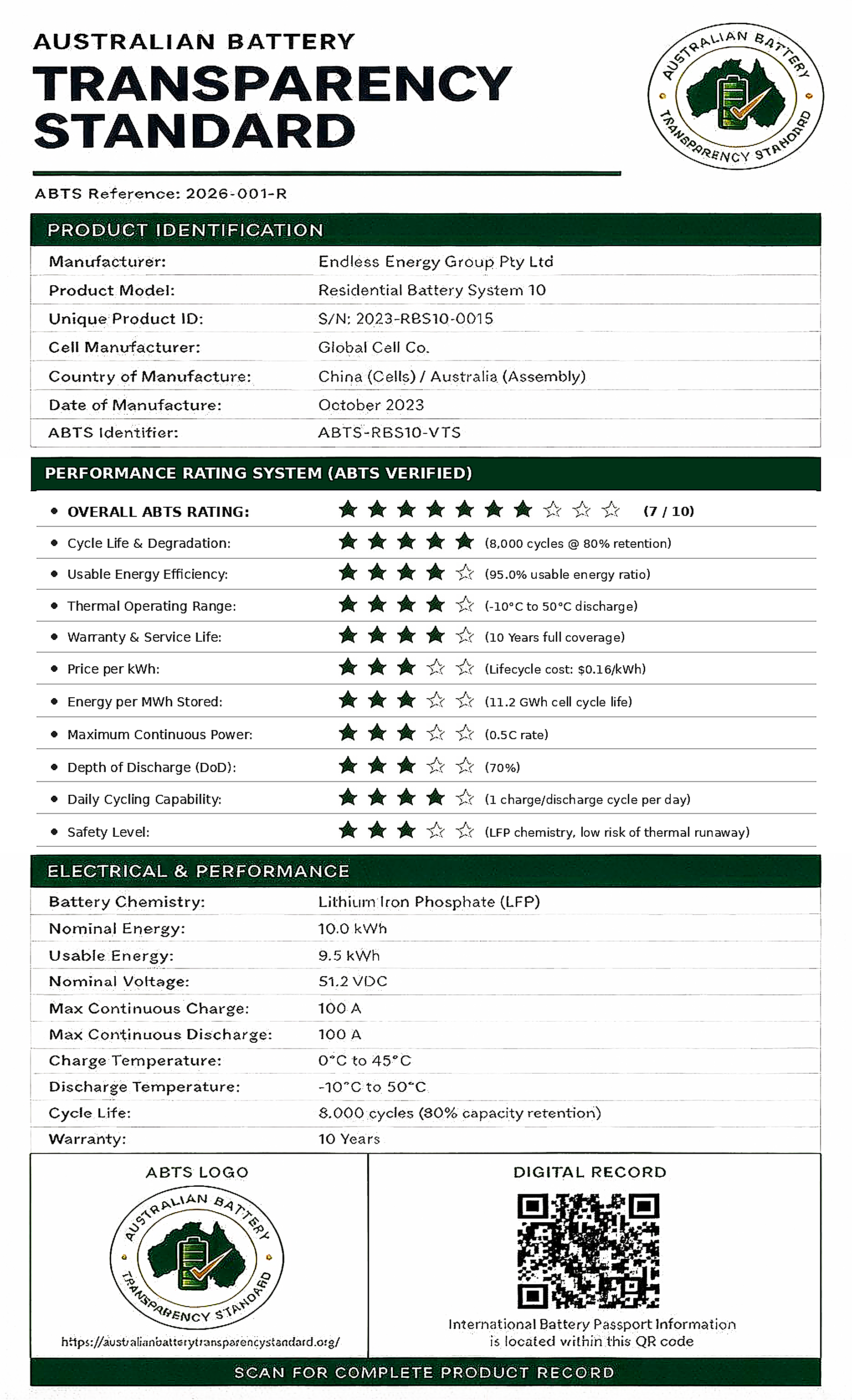
The ABTS certified product label
The essential facts.
The evidence behind them.
A simple, technology-neutral label giving every battery a clear identity and a transparent record of what it is, where it came from and what it claims to deliver.
Compare batteries
No rankings.
Only facts.
Choose any two of the eight chemistries in the supplied metric sheets to compare their performance, storage, warranty and cost information side by side.
Declared metricLithium Titanate Oxide (LTO)Lithium Iron Phosphate (LFP)
Performance metrics
Cycle life22,000+3,000 claimed; 7,000 at reduced depth of discharge
Charging time<10 mins1–2 hrs
Actual lifespan cycle capability60,000+5,475 based on cell count and reduced depth of discharge
Maximum lifespan cycle60,0002,500
RecyclabilityHighModerate
Operating temperature range−40°C to 60°C−20°C to 50°C with external heating/cooling
Risk of thermal runawayNoneLow
Environmental impactLowLow
SafetyVery highHigh
MaintenanceLowLow
Energy density110 Wh/kg90–120 Wh/kg
ScalabilityHighHigh
Performance with AISupportedModerate
Maximum continuous power6C0.5C
Cycles per dayUp to 201
Requires replacementAfter 60 yrsAfter 7–15 yrs
100% Australian companyYesNo
Weight500 kg350 kg
Storage and warranty metrics
Efficiency97.5%92%
Depth of discharge (DOD)100%70%
Capacity loss: 1 cycle/day for 15 yearsNegligible70%
Capacity loss: 2 cycles/dayNegligibleN/A
Air conditioning energy capacity loss1%3%
Air conditioning requirementNilHigh
Actual warranty period20 years or 22,000 cycles15 years
Energy per MWh stored: 1 cycle/day5.10 GWh6.24 GWh
Energy per MWh stored: 2 cycles/day10.3 GWhN/A
Energy per MWh stored: warrantied period22 GWh11.2 GWh
Energy per MWh stored: cell cycle life60 GWh11.2 GWh
Cost and economic metrics
Cost in USD$1M$0.7M
Upfront costHighModerate–high
Cost per MWh: 1 cycle/day for 15 years$196$160
Cost per MWh: 2 cycles/day for 15 years$99N/A, one cycle/day
Recycling cost: 15 years at $10/kg$230,000$300,000
Decommissioning cost: 15 years, amortised$5,000$20,000
Actual warranty period20 years or 22,000 cycles15 years
LCOE over warrantied period$50/MWh$160/MWh
Price per kWh: warrantied period$0.05$0.16
Lifecycle at maximum DOD60,0002,500
LCOE over lifecycle$23/MWh$160/MWh
Price per kWh: lifecycle$0.023$0.16
Total cost of ownershipExtremely lowHigh
Values reproduce the supplied metric sheets. ABTS does not recommend or rank chemistries, and claims should be independently verified.
Manufacturer certification
Applications are open for battery products.
Manufacturers and authorised product representatives can submit an initial application for an ABTS product assessment. ABTS then confirms the evidence requirements, reviews the submitted product information and establishes the digital record used for certification and label delivery.
Manufacturer and product identity Cell chemistry and technical data Safety testing and certifications Performance and operating limits Warranty and service-life claims Manufacturing and supply chain data Environmental and recycling information Australian market documentation
Programme resources
Framework and implementation documents.
Access the digital platform and OEM integration document together with the technical, policy and implementation materials that underpin the ABTS programme.
0102030405060708091011121314
ABTS digital platform, digital label, membership and OEM integration
The implementation document for manufacturer onboarding, digital product records, label delivery and OEM integration.
Battery product transparency and digital product record framework v0.1
The current ABTS framework connecting the physical transparency label with a broader digital product record.
Australian Battery Transparency Standard white paper
The July 2026 white paper presenting the proposed ABTS framework and its policy rationale.
Proposed Australian Standard framework
The proposed AS/NZS framework for an Australian Battery Transparency Standard.
Proposed mandatory battery transparency label
The proposed July 2026 design and requirements for a mandatory battery transparency label.
Draft battery transparency legislation
Draft Clean Energy Regulator amendment legislation for battery transparency in 2026.
Regulatory impact statement
The July 2026 regulatory impact statement for the proposed ABTS framework.
Cost benefit analysis
The July 2026 assessment of the proposed framework’s costs and benefits.
Environmental impact assessment
The July 2026 assessment of environmental considerations associated with the framework.
International comparison
A July 2026 comparison of relevant international battery transparency approaches.
Implementation roadmap
The July 2026 roadmap for progressing the ABTS framework from proposal to implementation.
Phased operational transition and enforcement protocols
Proposed July 2026 protocols for phased transition, operation and enforcement.
Proposed rebate eligibility amendments
Proposed July 2026 enforcement amendments relating to battery rebate eligibility.
Concluding strategic framework
The concluding July 2026 strategic framework that informed the ABTS implementation programme.
Implementation pathway
The programme has moved from design to delivery.
The foundational framework and first digital product record are established. ABTS is now onboarding a battery manufacturer, reviewing product evidence and progressing the first certification implementation.
- 01FoundationResearch and framework design
- 02PlatformDigital product record established
- 03Current phaseManufacturer onboarding and product assessment
- 04DeliveryCertification, label issue and record maintenance
Certification questions
What manufacturers need to know.
ABTS certification is a product-level transparency process built around manufacturer declarations, supporting technical evidence and a maintained digital product record.
Can a product apply for ABTS certification now?
Yes. Battery manufacturers and authorised product representatives can submit the application on this website to begin product onboarding and evidence review.
Does submitting an application guarantee certification?
No. An application opens the assessment process. Certification is issued only after the required declarations, documents and supporting evidence have been reviewed and accepted.
Does ABTS favour one battery chemistry?
No. ABTS is technology neutral. Products are assessed against consistent transparency requirements without prescribing a preferred chemistry.
How are batteries assessed?
The process combines structured manufacturer declarations, relevant test and certification documents, supporting performance evidence and review of the information used in the ABTS label and digital record.
What happens after certification?
The certified product receives an ABTS record and label pathway. Product information must remain current, and material changes may require the record or certification evidence to be updated.
Can OEM data be integrated?
The implementation programme is designed to support manufacturer onboarding and future OEM integration so existing product data can be reused rather than unnecessarily duplicated.
Manufacturers & Industry Supporters
Backing battery transparency in practice.
ABTS recognises the organisations backing the programme in two categories as it moves into manufacturer onboarding, product records and certification delivery.
Sponsorship or support does not confer product certification, endorsement or influence over an ABTS product assessment.
01
Manufacturers
Battery manufacturers and product owners committed to transparent, evidence-based product information.
Apply as a manufacturerBattery manufacturer

Manufacturer supporting ABTS
Zenaji
ABTS acknowledges Zenaji as a battery manufacturer supporting transparent product information.02
Industry Supporters
Industry organisations and individuals who have publicly pledged support for an independent Australian standard.
Pledge your supportFounding industry supporterProud sponsor

Founding industry supporter
Endless Energy Group
ABTS acknowledges Endless Energy Group as a founding industry supporter and proud sponsor.Supporting organisation

Programme supporter
Solar Subbies
ABTS acknowledges Solar Subbies as a supporter of the programme.Supporting organisation

Programme supporter
Abundant Power Solutions
ABTS acknowledges Abundant Power Solutions as a supporter of the programme.Supporting organisation

Programme supporter
AHA Accounting + Business Solutions
ABTS acknowledges AHA Accounting + Business Solutions as a supporter of the programme.“I love this initiative and cannot believe that we did not already have this in place. Well done Mr Fawaz.”
Supporting organisation

Programme supporter
Dynovy
ABTS acknowledges Dynovy as a supporter of the programme.“Dynovy supports the objectives of the Australian Battery Transparency Standard (ABTS) initiative to improve battery transparency, lifecycle information and informed decision-making. We recognise the importance of reliable battery health and performance data in supporting battery assessment, reuse, repurposing and recycling, and welcome opportunities to explore how diagnostic insights may complement greater transparency across the battery lifecycle.”
Get involved
Choose the option that suits you.
ABTS works with three groups. Select the pathway that matches your organisation to see what is involved and submit the right application.
Certification
Manufacturers
Apply for ABTS product certification, a verified digital product record and the ABTS Transparency Label.
Suitable for
Start a manufacturer application - Battery manufacturers and brand owners
- Authorised product representatives
- OEMs integrating product data
Partnership
Partners
Work with ABTS to fund, deliver or integrate the programme through sponsorship or a formal collaboration.
Suitable for
Make a partnership enquiry - Sponsors and industry bodies
- Installers, distributors and retailers
- Government, research and technology providers
Public pledge
Supporters
Publicly pledge your support for an independent Australian Battery Transparency Standard.
Suitable for
Pledge your support - Any organisation backing transparency
- Individuals and consumers
- Community and advocacy groups